Choosing reliable Ascorbyl Palmitate suppliers requires more than comparing prices on a spreadsheet. Global buyers need stable quality, clear documentation, and practical export experience. Ascorbyl Palmitate is a fat-soluble vitamin C derivative used in supplements, functional foods, cosmetics, and selected antioxidant applications. Its performance depends on purity, particle characteristics, packaging, and storage conditions.
Professor Barry Halliwell, a respected antioxidant researcher, explains, “An antioxidant is a molecule that inhibits the oxidation of other molecules.” This simple statement highlights an important sourcing point. Buyers should ask how each supplier verifies antioxidant quality. A dependable supplier should provide a current certificate of analysis, assay results, microbiological data, heavy-metal testing, allergen information, and batch traceability. GMP compliance and ISO-based quality systems also deserve careful review.
Look closely.
Packaging matters. Moisture-resistant bags, sealed drums, and controlled warehouse conditions can help protect the powder during long-distance transport. Suppliers should also explain shelf life, recommended temperature ranges, and handling requirements. A professional export team can support documentation, customs preparation, and consistent communication across time zones.
However, no supplier is flawless. Some websites present impressive claims but provide limited technical evidence. Product photographs may look polished, while batch records remain unclear. This is where buyers must remain skeptical and verify details directly. Requesting samples, reviewing recent test reports, and checking production capacity can reduce unpleasant surprises.
This guide examines China’s leading Ascorbyl Palmitate suppliers for global buyers. It focuses on quality controls, certifications, customization, logistics, pricing transparency, and long-term reliability. The strongest partner is not always the cheapest. It is the supplier that can repeatedly deliver compliant material, accurate documents, and honest answers.
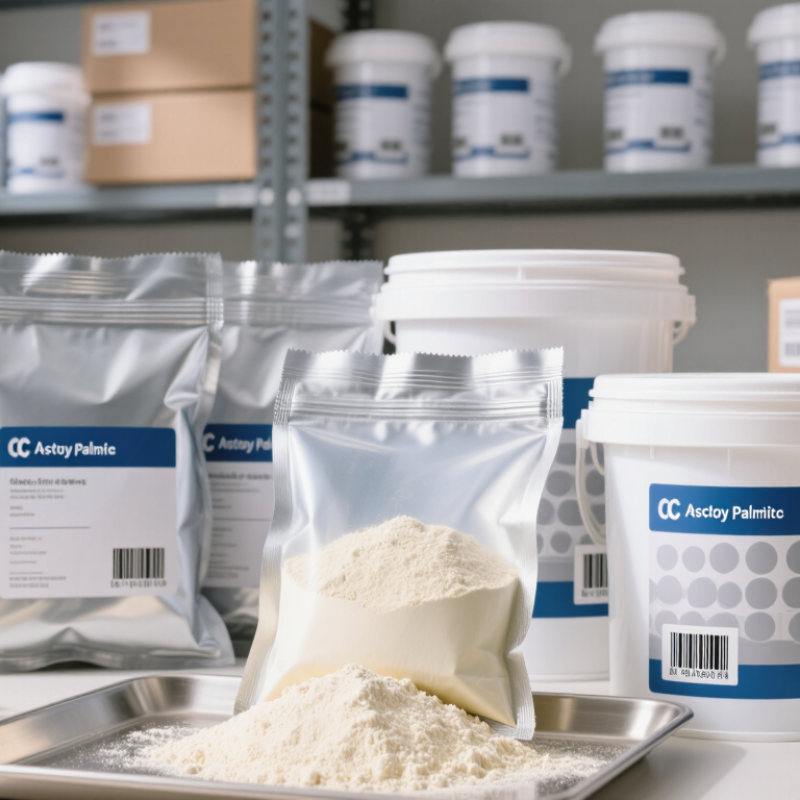
Ascorbyl palmitate is a fat-soluble derivative of vitamin C. It combines ascorbic acid with palmitic acid, a fatty acid. This structure helps it disperse in oils rather than water. Manufacturers use it mainly as an antioxidant in food, supplements, and personal-care formulations. It can help slow oxidation in oil-based products, protecting color, flavor, and freshness. However, it should not be treated as a complete replacement for water-soluble vitamin C. Its performance depends on dosage, temperature, packaging, and the surrounding formula.
For global buyers, quality assessment requires more than a low quoted price. Ask for a recent certificate of analysis, assay results, appearance, heavy-metal data, microbiological results, and storage conditions. Confirm the material’s intended application and review its stability during shipping. A pale, uniform powder is usually expected, but appearance alone proves little. I have seen specifications look acceptable while packaging information remained unclear. That detail deserves attention. Reliable suppliers should explain testing methods, batch traceability, and shelf-life evidence without making exaggerated health claims.
Tips: Store ascorbyl palmitate in a cool, dry, light-protected area. Use sealed packaging and avoid repeated exposure to air. Check compatibility with oils, emulsifiers, and other antioxidants before production. Small pilot trials are worthwhile. Product performance can change after scale-up.

Ascorbyl palmitate is a fat-soluble ester formed from ascorbic acid and palmitic acid. Its lipid-compatible structure makes it suitable for oil-based foods, cosmetics, and personal-care formulations where antioxidant protection is required. The chart compares the molecular weights of selected vitamin C compounds; the values are molecular properties rather than company or brand data.
Global buyers evaluating China-based ascorbyl palmitate suppliers should examine quality systems before discussing price. The supplier should provide a clear specification sheet and a batch-specific certificate of analysis. Identity testing, assay results, melting range, moisture, heavy metals, and residual solvents need defined limits. Microbiological data may also matter for certain food and cosmetic applications.
Traceability is equally important. Each batch should connect to raw material records, production dates, testing results, and warehouse conditions. Proper packaging should protect the powder from heat, light, and moisture. Ask how samples are collected and retained. A polished certificate means little if the sampling process is weak. It happens.
Supplier facilities should demonstrate controlled production practices, documented cleaning procedures, calibrated instruments, and trained laboratory staff. Independent testing can confirm critical results, especially before a large shipment. Buyers should also review stability information under realistic storage conditions. Global requirements differ, so technical documents must match the destination market and intended use.
No supplier is flawless. The better question concerns how openly a supplier handles deviations, complaints, and corrective actions. A reliable partner responds with evidence, not vague promises. Video audits, factory visits, and consistent communication can reveal gaps that certificates miss. Quality decisions should consider performance across several batches, not one attractive sample.
Buyer-focused quality and compliance reference for evaluating ascorbyl palmitate suppliers. Commercial acceptance limits should be confirmed in the purchase specification, product standard, and certificate of analysis.
| Quality Dimension | Verified Data or Recommended Acceptance Criteria | Common Test Method or Reference | Why It Matters to Global Buyers |
|---|---|---|---|
| Chemical Identity | Ascorbyl palmitate; CAS No. 137-66-6; also known as 6-O-palmitoyl-L-ascorbic acid. | Identity confirmation by HPLC, IR spectroscopy, or comparison with an authenticated reference standard. | Confirms that the supplied material is the requested vitamin C derivative rather than another ascorbate or blended product. |
| Molecular Formula | C22H38O7; relative molecular mass approximately 414.54. | Calculated from the defined chemical structure; verify identity using a validated analytical procedure. | Useful for technical dossiers, formulation calculations, customs documentation, and analytical method development. |
| Food-Additive Classification | Recognized as antioxidant food additive E304(i) in the European Union and INS 304(i) in the Codex International Numbering System. | Applicable food-additive legislation in the destination market. | Supports regulatory screening before importation and use in food, dietary supplement, or nutrition applications. |
| Appearance | White to pale yellow powder or crystalline powder; the material should be free from visible foreign matter, abnormal discoloration, and agglomerates that cannot be dispersed. | Visual inspection under defined lighting and sampling conditions. | Provides a rapid indication of contamination, oxidation, poor storage, or inconsistent production. |
| Assay / Purity | Common commercial specification: not less than 95.0% ascorbyl palmitate. Higher limits may be agreed for pharmaceutical, nutraceutical, or specialty applications. | Validated HPLC assay using an appropriate reference standard; report result on the stated moisture basis. | Assay affects formulation performance, labeling calculations, cost-in-use, and batch-to-batch consistency. |
| Identification Profile | Chromatographic retention time and spectral profile should correspond to the approved reference standard; no significant unidentified peak should be present above the agreed reporting threshold. | HPLC or UPLC with system suitability, supported by IR or another orthogonal identity test where required. | Helps detect substitution, degradation products, residual starting materials, or cross-contamination. |
| Melting Range | Typically reported around 107–117°C for ascorbyl palmitate, subject to method, polymorphic form, and specification basis. | Capillary melting-point determination or differential scanning calorimetry using a documented procedure. | Useful as a supplementary identity and consistency check; it should not replace chromatographic assay. |
| Solubility Characteristics | Practically insoluble in water; soluble or dispersible in suitable organic solvents such as ethanol, depending on concentration and temperature. | Qualitative solubility test under controlled solvent, temperature, and concentration conditions. | Important for selecting production equipment, premix systems, carriers, and final dosage-form processes. |
| Moisture / Loss on Drying | Set a buyer-specific maximum, commonly based on product stability and application requirements; the limit must be stated together with the test basis. | Karl Fischer titration for water or loss on drying where appropriate. | Excess moisture can increase clumping, reduce flowability, and accelerate degradation during storage. |
| Residual Solvents | Must comply with the applicable destination-market requirements and the limits for the solvent classes used in manufacturing. | Headspace gas chromatography; evaluate against ICH Q3C or the relevant food and pharmaceutical requirement. | Demonstrates that manufacturing solvents have been adequately removed and documented. |
| Elemental Impurities | Lead, arsenic, cadmium, mercury, and other relevant elements should comply with the legal limits applicable to the intended use and destination market. | ICP-MS or ICP-OES after validated sample preparation; report each element separately. | Supports food, supplement, pharmaceutical, and export compliance assessments. |
| Microbiological Quality | Define total aerobic microbial count, total yeast and mold count, and absence or limits for specified pathogens according to the intended application. | Applicable pharmacopoeial or food microbiology methods, such as ISO or equivalent validated procedures. | Microbiological limits vary by end use; a clear specification prevents unsuitable material from entering production. |
| Oxidative and Storage Stability | Supplier should provide real-time and, where available, accelerated stability data covering assay, appearance, odor, and degradation profile. | Stability testing under defined temperature, humidity, light, packaging, and time conditions. | Ascorbyl palmitate is sensitive to processing and storage conditions; stability data supports shelf-life and transport decisions. |
| Packaging | Use sealed, food-grade or pharmaceutical-grade inner packaging with protection from light, moisture, and oxygen; the exact configuration should match the approved stability data. | Packaging specification, container-closure assessment, and visual inspection at receipt. | Appropriate packaging helps preserve assay, flow properties, and appearance during international transport. |
| Traceability | Each shipment should have a unique batch number, manufacturing date, retest or expiry date, net weight, storage conditions, and country of origin. | Review of the label, packing list, certificate of analysis, and batch manufacturing records. | Enables recall control, complaint investigation, customs clearance, and inventory management. |
| Certificate of Analysis | CoA should include batch-specific results for appearance, identity, assay, moisture, impurities, microbiology where applicable, test methods, specification limits, and authorized approval. | Document review; laboratory accreditation and method validation evidence may be requested. | A batch-specific CoA is essential for release decisions and should not be replaced by a generic product specification. |
| Quality-System Evidence | Request evidence of a documented quality management system, change-control procedure, deviation and CAPA process, complaint handling, and supplier qualification controls. | Quality questionnaire, audit, certification review, and controlled-document assessment. | Quality-system maturity is a stronger indicator of long-term supply reliability than a single passing test result. |
| Storage and Transport | Store tightly closed in a cool, dry, and dark location; avoid excessive heat, humidity, and prolonged exposure to air. Follow the supplier’s validated storage recommendation. | Warehouse records, transport conditions, temperature and humidity monitoring where required. | Correct logistics conditions reduce oxidation, moisture uptake, caking, and out-of-specification results after arrival. |
Procurement note: The acceptance criteria shown above are a practical qualification framework rather than a universal specification. Buyers should align the final limits with the intended application, destination-country legislation, applicable pharmacopoeial or food standard, approved analytical methods, and the supplier’s validated product specification.
A reliable evaluation starts with product identity and manufacturing evidence. Ask for the specification, assay range, appearance, solubility data, and batch-specific COA. Check whether testing uses validated methods, such as HPLC, rather than vague internal descriptions. A clear lot number should connect the product, test report, and production record. Small details matter.
Review the factory, not only the trading office. Request information about GMP practices, raw material controls, allergen handling, cleaning procedures, and contamination prevention. A suitable manufacturer should explain its quality system without avoiding difficult questions. Confirm production capacity through recent batch records, not impressive annual figures. Samples should match the approved specification after storage and transport trials. Stability data under heat and humidity can reveal weaknesses early.
Supply reliability also depends on traceability and communication. Evaluate packaging, moisture protection, shelf-life labeling, and export documentation before placing a large order. Independent testing can verify assay, impurities, heavy metals, and microbiological limits. It adds cost, but it reduces uncertainty. One common mistake is trusting a low price too quickly. I have seen buyers focus on the first quotation and overlook response speed, corrective-action records, or inconsistent documents. That approach needs reconsideration. A factory may look professional and still lack dependable batch discipline. Ask precise questions, record each answer, and compare evidence across several production lots.
Export preparation for ascorbyl palmitate starts with identity control. Codex GSFA lists it as INS 304, an antioxidant used in permitted food applications. The FAO/WHO JECFA database records its acceptable daily intake as “not specified,” reflecting safety assessment under intended use conditions. Buyers should still request a current specification, assay result, heavy-metal limits, microbiological results, and a batch-specific certificate of analysis. Documentation matters.
Packaging must protect this powder from light, heat, oxygen, and moisture. Practical export packaging often includes a food-grade inner liner inside fiber drums or multilayer bags. The outer label should show product name, net weight, lot number, production date, shelf life, storage conditions, and country of origin. Keep it dry. Desiccants can help, but they do not replace a reliable moisture barrier. Temperature and humidity records during loading are useful evidence when claims arise.
Compliance files should match the destination market. Prepare the SDS, allergen statement, GMO declaration, origin certificate, commercial invoice, packing list, and transport documents. EU buyers may request additive specifications under Regulation (EU) No 231/2012, while other markets apply different limits and labeling rules. A supplier should verify each shipment against current local requirements, not rely on an old template. One weak point remains: packaging claims are sometimes copied without testing. Independent review is wiser, especially after long sea transport.
Selecting the right ascorbyl palmitate supplier requires more than comparing prices. Global vitamin C demand continues to expand. Grand View Research valued the global vitamin C market at over USD 1.9 billion in 2023. This growth increases pressure on supply consistency and quality control. Buyers should request current certificates of analysis, HPLC results, allergen statements, and residual solvent data. A reliable supplier should explain its testing methods clearly. Vague answers deserve attention.
Tips: Check GMP certification, batch traceability, packaging protection, and lead-time records. Ask for at least three recent batch documents. Confirm assay, moisture, heavy metals, and microbiological limits. Also review storage conditions. Ascorbyl palmitate can suffer quality loss when exposed to heat, oxygen, or light. A foil-lined container may be more suitable than ordinary plastic. Small details matter.
The ISO Survey 2023 recorded more than 1.5 million valid ISO 9001 certificates worldwide. Certification is useful, but it does not prove every batch is perfect. I have seen purchasing decisions rely too heavily on certificates. That is a weakness. Request an independent audit or a recent third-party test when the material supports food, nutrition, or cosmetic production. Compare minimum order quantities, production capacity, customs documents, and emergency response times. A dependable supplier should provide consistent communication before payment, not only after a problem appears.